Showing posts with label companion planting. Show all posts

Saturday, May 19, 2012

Bush Bean Redland Pioneer Life Cycle

The first bush bean that we grown was 'Redland Pioneer' in our garden and has been the best performer among the bush beans we have tried (not many though still to compare with). But it has been the most reliable bean to fill in the hungry gap. Bush bean grows really fast and provide some beans in 7~8weeks of growing, sometime earlier if the weather is preferable for their optimum growth. It is really an important veggie in our garden since it fill the hungry gap in spring and again in fall. We sow 'Redland Pioneer' bush bean 3 times a year-spring, summer and autumn. Well, rather than leaving the soil bare after harvesting other veggies, we might as well grow beans so they help fix nitrogen into the soil again. Its a win-win situation. I feel that bush bean seeds does not require much water to germinate, too much water can cause the seeds to rot easily in cool season. A really good veggie for a lazy gardener like me, bush beans not a heavy drinker and not a heavy feeder.
Bush bean 'Redland Pioneer' seedlings'
Because we don't have that much space to grow and very greedy, I tried to maximize the space we have by planting the plants densely together in spring/summer. I can get away growing them densely in a spot with full sun because they don't compete each other with light and it helps keep the soil moist longer as it is covered with the foliage. Less evaporation. Save money from buying mulch. I gave up with mulching this year because the bird will cause serious damage by their scratching habit on seedlings. Last spring when we transplanted tomato at this area, we direct-sowed bush bean seeds around the tomato seedlings. It did very well and the tomatoes grow without any fuss. Humidity is very low in our garden warm season here so our tomato plants can readily accept being close to other plants and I don't have to worry about good air circulation.

Beans grow well in partial shade too. But not as prolific as in full sun which you get more beans to harvest. In partial shade, I probably plant shorter plants together with beans to give the bean plants more light and not to over-shadowed them. We had many violas flower plant volunteers one spring season, and I transplanted them as border plant just to make the garden look more colourful. If in tropics, I can imagine portulaca (moss rose) growing in the viola place instead. At the back row are Bloomsdale spinach young plants.

Bush Bean Redland Pioneer very prolific.
At their pick season, just a few plants will give you enough harvest for an average family number.
I have been growing them for 3 years but this is the first time/year I really collected their seeds. I have been trying to collect them earlier last year but its hard to get the seed pod dried properly in autumn season.  I also found sprouted bean seeds in the seed pods during autumn. So this time I let the summer heat wave do the quick drying process for me.
Shining harvested bean seeds.
After I harvested the seeds, I planted some of our home-grown seeds. I felt very satisfied with the results and the new harvest from plants grown from our home-grown seeds. Contentment.
Have a lovely weekend!

Friday, March 23, 2012

Early Fall Container Garden

I have not posted about our container garden at our small backyard since last year. Well nothing really nice to see last summer. The plants were struggling to survive back then and not much growth. It still not very nice to look at even now. The mild weather has made some of the plants grow crazy and now they grow wild. The plants have a mind of their own now. For example this spot, I have to scratch my head trying to remember what is growing here~watermelon, capsicum, parsnip, lemon basil, purple sweet potato, okra, kailan and jicama. Can you tell which is which? If you have a small place or even garden on a balcony, this kind of gardening is still possible. This is about 1 metre X 1 metre. Suits for a location that received at least 6 hours of direct sun.

What is growing in this 30 cm X 40 cm polystyrene container?
Cucumber plants climbing on the trellis, banana capsicum and carrots.
Not supposed to be there beetroot also wants to grow there.

Half of our backyard receive morning sun and the other half received afternoon sun.Took the photo in the morning and you can see the clear line light and shadow separation.This is the spaggetthi squash that I sowed last January in container to replace the ones that died due to the extreme heat. Very happy with the attempt because we already have squash in March, did not expected that it will give us fruit so fast. Its actually 2 plants in the same container and each plant has fruit on it. One is hiding somewhere in the long grass. Hopefully this weekend, I have time to spend in the garden to cut the grass and sow some seeds.

The different length of the trellis? We pick them up from hard waste during spring cleaning week in our suburb. At the back, I have cleared some of the containers and sow some seeds for cool season vegetable here. There is one long dangling angled luffa can be seen at the background. Sweet potato harassing lemon grass plant. Sweet potato are becoming invasive as they start to sprout in many different places in containers and on the ground. Lemon basil also growing as they please.

It might be hard to believe but these sweet potato plants are actually growing from containers. There are a row of 4 containers. Now they entered other plants territories. This section has given me much headache and cause the biggest problem for other section of the container garden. Because of this, we have trouble with mice. The mice took shelter here from the heat. They come out during night and dug up holes all around the container garden which have cause many young seedling uprooted and direct-sowed seeds failed to germinate or possibly lost. I don't think I have much to harvest here since the mice might enjoyed some of the sweet potato tubers. But I will wait perhaps until May before I clear up this place for good.

Let me think what plants are growing here ( 1.5 metre X 1 metre) ~ okra, jicama, capsicum, bush bean, parsnip, purple sweet potato, water spinach (kangkung), carrots and bitter gourd. The jicama seems to like the mild weather now. But I must remember to harvest them next month because the edible root will rot when the weather drops below 15 degree Celsius in consecutive days. The jicama tuber won't be big cause they don't have enough sufficient growing time and those plants are just starting to produce flower bud. Last year the bud did not managed to bloom but let see will it bloom this year or not.

Hope one day we see many green balcony from tall buildings.
What's growing in your container garden?

Friday, November 4, 2011

Giant Purple Mustard Life-Cycle

Giant purple mustard grows very quickly and will be ready to harvest before main crop of summer or winter vegetables are ready to be harvested. For continuous supply of fresh vegetables from the garden before others are ready, giant purple mustard can fulfilled that hope. It can be inter-planted with other vegetables to maximise space and productiveness of small gardens. Mustards can be treated as green manure and it is said to help control nematodes as well. Inter-planting mustard with plants that is easily effected by nematodes as companion plant will deter nematodes.Giant purple mustard is very tolerant to cool weather. Giant purple mustard leaves will turn to more purple colours in cold weather.
Giant purple mustard seedlings sown in late fall.
Giant purple mustard seedlings sown in the end of summer.
Giant purple mustard can also be grown as trap plants or sacrificial plant to attract pest to them. So that main crop brassica like broccoli, cabbage or cauliflower will be safer from pest attack. Broccoli and cauliflower takes long time to grow, inter-planting mustard around them will  give many benefits to the brassica and productivity of ones garden like deterring nematodes, act as decoy to pest that like brassica and keep soil evaporation low as ground cover. 
Purple Giant mustard ready to be harvest.
If letting them grow much bigger it will become too bitter.
Inter-planting potatoes with mustards.
Time to harvest those mustards which will give potatoes some space to grow.
Giant purple mustard can grow the same size as mature broccoli plants.
The dark purple leaves of this mustard is very striking in the garden.
Giant purple mustard starting to flower.
Blooming.
Flowers of the purple giant mustards attract bees into the garden.
Producing seed pods.
Have a nice weekend.

Saturday, October 29, 2011

Cineraria for company

This is our second year growing cineraria. Last fall, we found many self-sowed cineraria in our garden. So we scooped those volunteer seedlings and tried to make it as border plants. Wishing that it will gift us with spring blooms and add colours in the garden after a green winter. I like to try different combination of flower plants with edibles because I can't draw any form of flowers on a canvas at least I can make a design on a patch. It was fun to see if cineraria can be a good companion or not.
Cineraria plants with Nero Black Kale side by side at our semi-shade patch.
On the same patch, last year lay-out.
A few months later,, plants starting to grow and filling the space.
Cineraria as a border and growing with celery.
Have a nice weekend!

Monday, May 16, 2011

Companion Week Side Bar Button

I hope the give-away seeds will arrived safely to the author of the blog above.

Sunday, May 1, 2011

Shade for Turmeric in Hot Weather (Companion Planting)

Growing turmeric in temperate (Mediteranean) climate is not easy if you don't have a greenhouse like us. Turmeric needs 7~9months to grow in warm weather to produce good decent roots to harvest. Only one plant gave us a small harvest when it died last winter. I am trying again to grow turmeric this year by not repeating mistakes we did previous year in Adelaide. During warm season, turmeric prefer to grow in partial shade. Growth of turmeric will be stunted or the plants died after several days of receiving harsh light from the sun during Adelaide summer. Turmeric grows wild in the dense South-East Asia tropical forest under big trees which shows having a character of thriving in partial shade. Turmeric relies on other big plant to provide some shade.
Have you ever wonder when you have limited space what you can grow under the trellis? Many root crops like carrot, turnip or garlic need full sun to grow fat roots but turmeric is one of the exception. In our garden, under bittergourd and bean plants, turmeric managed to grow well during summer. I also found many turmeric that come out from compost which is growing under tomatoes and peppers. These turmeric plants grow very fast in the shadow of these two plants compared to turmeric plants that received full sun in summer. Turmeric is said to repel black ants. Black ants can host aphids which usually like to attack tomato, eggplants and pepper plants. Turmeric can be good companion for eggplants, peppers and tomatoes to reduce pest attack and these plants provide some shade for turmeric.
In winter, turmeric might need more sun for warmth. I will moved this container that have two turmeric plants near our house brick wall to reflect some heat during the night which recieved full morning sun. Last year, the last growing turmeric (dormant) survived until middle of winter in the open garden.
What is "Companion Week" and Seed Give-Away visit this post for more information.
Thank you for linking.

Saturday, April 30, 2011

Chili and Big Brother Broccoli

These chili plants are at least 15 months old and have survived through one winter season without any tender loving care. It is fruiting many chilies now and we can started freezing some. We are harvesting chili alternate days. These chili plant like the mild weather we are having now here in Adelaide. At my parents house, chili is always available at home because my father (Orang negeri) have to have some spicy food on the table. My mother have been controlling my father meal portion by not cooking spicy dish. Poor papa, no fun at the table and less appetite. 

I wanted to make spicy green mango salad tonight and there were no chili in the kitchen, with the help of the front door light I can see some red ones. This is a very quick dish to prepare 2 green mango thinly slice, mashed shrimp paste (belacan), pounded roasted peanut and chili (depend on you hotness tolerance), a bit of salt, squeeze one or two lime/lemon for juice and mix well. Join in Wendy's Garden to Table Challenge.

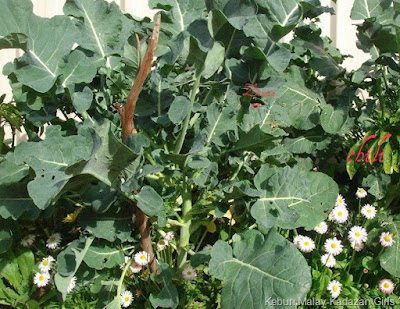
Who took good care and made sure that these chili plants survive the winter? This good buddy became a wind break, shelther chili from the cold and strong wind. It blanketed and warm these chili plants through winter. Brocolli was like a brother to chili as it grows taller than chili, it help shelther the fragile chili against the cold wind. It is difficult to see chili plants on the left and right side of the photo as the angle taken is not good. Some self-sowed blooming zinnias growing happily in between broccoli plants in winter, did it help attract predators? Did white English Daisy bloom help to confuse butterfly to lay eggs on the leaves?
Hmmm...how did this relationship began in this 1 X 1 permetre square patch? Perhaps you can spotted some self-sowed zinnia in last fall here in the picture. Red onion interplanted in the middle with 4 broccoli plants, help to reduce pest attack. Can't see the chili plant because it is supposed to be growing at the left and right sides of these 4 broccoli plants. At this stage, broccoli closely resemble Chinese Broccoli (kailan) and taste similar too because the cook harvested broccoli instead of kailan without the gardener noticing the mistake until a few days later.
Cauliflower and broccoli growing together with calendulas (Pot Marigold) which is an edible flower and make a nice border. Broccoli plants were taller than Rayyan who were 11 months old at that time.
What to do when you have excess seedlings of Chinese Broccoli? Inter-plant Chinese Broccoli with garlic to mask scent and reduce pest attack. Yes, it is very hard to produce a perfect-looking kailan. Chinese Broccoli grow fast which in 2 months it will be ready to be harvested and with it shallow and small root it won't bother the slow-growing garlic. Save space in the garden too.
When growing many variety of vegetable in a patch, I see many kind of relationship form in our garden. Broccoli giving shelther naturally to our chilis and calendula brighten the patch with special network in the soil. I am planning to grow purple sprouting broccoli side by side capsicum plants this fall and scoop some self-sowed coriander seedlings to transplant it around broccoli for safe measure. Hopefully when these corinder bolt it will help to nurse back the capsicum plant if it needs help.
Another 2 days it will be the end of "Companion Planting Week" in my blog. Thank you for sharing your knowledge and advice on companion planting. Hope more will share and give some ideas with Companion Planting.
What is "Companion Week" and Seed Give-Away visit this post for more information.

Thursday, April 28, 2011

Leek Lucky Mate

My Leek confession:
1) I can't remember my first taste of leek but it must be in Japan when I buy ready-made set for nabe ryouri, ignorant that the cut veggies in the pack is leek. I must have eaten leek many times in Japan when I dine outside with friends but not paying attention on what I am eating.  My first taste of leek will be when I am already adult which is just a few years ago;-).
2) Leek is a new vocabulary to me. I know what leek is when we bought our first leek seeds through catalog last year because we wanted a new variety in the garden growing well in cool season.
3) My cousin Lenay has never known Leek until we grow them in the garden and had her first taste of leek from our home-grown.
4) I have never bought any leek since I married my husband.
Leek is very easy to grow and almost pest free. Don't need much water. Grow in full sun. Great as companion to other vegetables. Not sure about peas and beans though, I have never tried growing them together because so many companion planting referance said that allium family and beans don't like each other.

Leek grows well with pansy or viola in the garden. This combination make the garden look more ornamental. I really like growing leek in the front yard because combination of leek with any vegetables makes the garden more pretty.Pansy help cover the leek stem like blanching. At the back of leek are carrots and onion grown from sets.

Carrot and leek is a well known combination of companion planting.
This is an odd companion gardening , Europe and Asian fusion~chives, leeks and water spinach in the same pot. These allium help to reduce water spinach pest attack.
What is "Companion Week" and Seed Give-Away visit this post for more information.
Thank you for linking.

Monday, April 25, 2011

Solitary Sunflower

Sunflower makes the garden look so cheerful and inviting for pollinators or predators.

 However, behind that cheery smile on sunflower face, it is almost destine to live all alone without having other companion than its siblings. Plants that grows together with sunflower will have less yield for example sweet corn or the cucurbits (zucchini, melon, cucumber). Sunflower inhibits the growth of potatoes and ginger. Last spring, we planted rows of sunflower at the back of the fence. Lenay planted sprouted potatoes and gingers in between these sunflowers without my knowledge. When we were cleaning up the patch after sunflower has finished their life-cycle to prepare for fall plantings, found many ginger and potato sprouts that are just about to push their new stem out from the soil. Potatoes, ginger and sunflower don't get along together at all.
Since sunflower can grow so tall, I entertain the idea that climbing bean growing beside sunflower can take advantage of using sunflower as trellis. The direct-sowed climbing bean (snake bean) germination was not good and growth were stunted. I tried direct sowing both sunflower and edamame (soy bean) seeds on the same patch but only one bean seeds sprouted whereas sunflower had no such problem. I reckon after 2 trials of growing diffrent variety of bean on the same patch with sunflower, I won't grow them together again anymore. Sunflower is good green manure and compost material. Since we can't use sunflower while they were a living plant as a trellis, we used the stalk now for peas or snow peas trellis during the cool growing season.
I like to fully utilise the space that we have in the garden, can anyone share their success of growing any plants together with sunflower?

Thank you for linking.

Carrot and Cucurbit

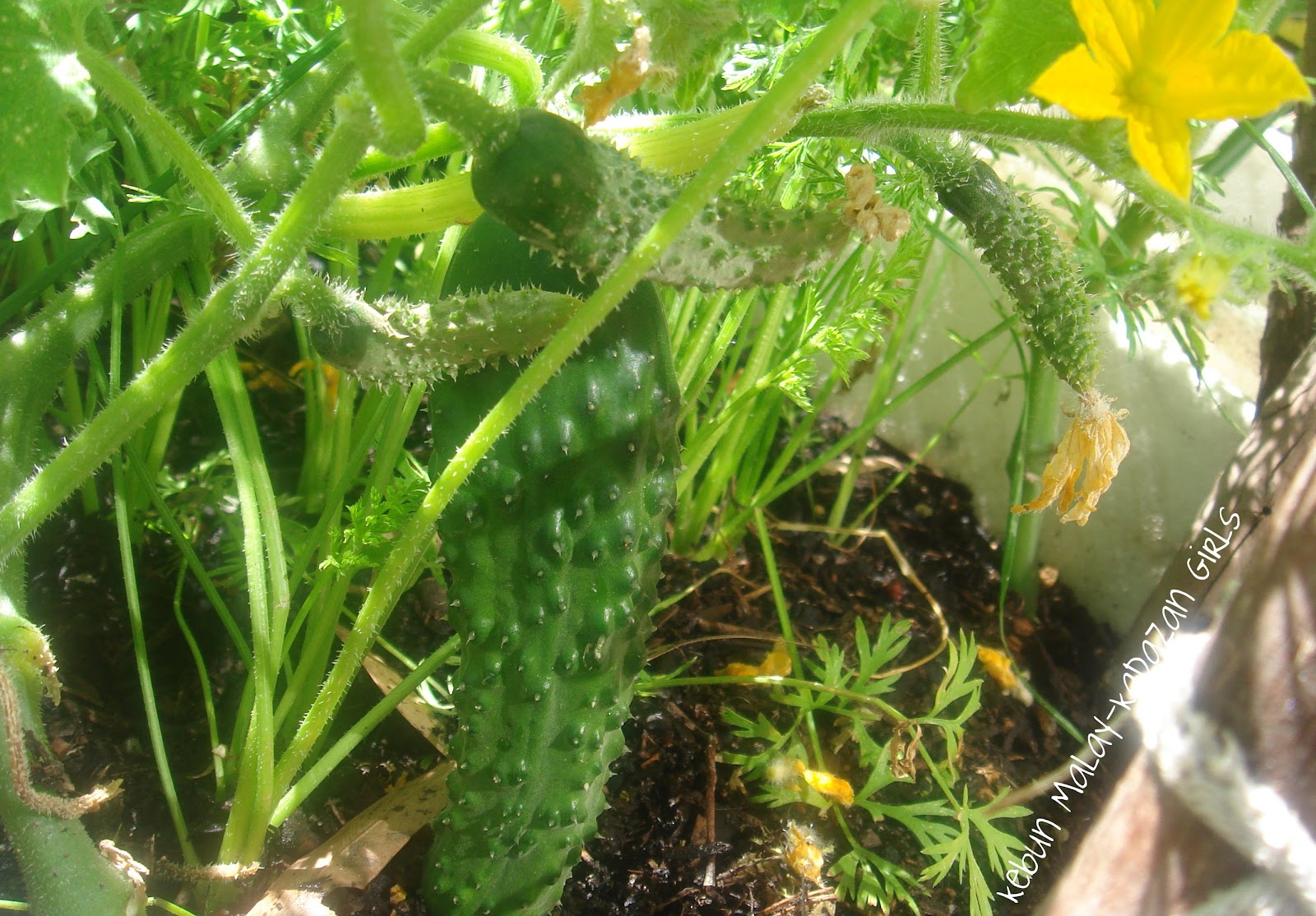
We never grow enough carrots. Rayyan eat most of our carrot harvest. Making sure that we have some carrot for Rayyan every week, I have to try to sow carrot seeds every month. Growing carrot during summer here in Adelaide is a bit challenging as the temperature is high and good germination will be a problem. Furthermore, the harsh burning rays of Adelaide summer sun can burn the leaves to crisp. I found that 'New Red Kuroda' carrot variety can tolerate heat (good and fast germination) which is reliable for growing carrot in summer. Carrot takes a long time to grow and space is very precious in our garden so I have to think of  a way I can give some shade to protect carrot from getting itself cooked in the soil and of course space vacancy. While we tested growing cucumber in container, there were a lot of empty spaces so we decided to sow some carrot seeds and see whether carrot and cucumber can grow happily together or not. YES they do!
Cucumber yied were good and carrot size were not too bad either.
Carrot thinnings.
Rarely have the chance to take photo of our carrots because it goes directly to the cooking pot for Rayyan meal.

This is what happened to the carrots growing together with bitter gourd after several days of 40+ degree Celsius. Bitter gourd foliage gave some shade protection for the carrots. Imagine if carrot were totally at the mercy of the sun, surely they will die.
Carrot which we sowed in the middle of last summer, growing together with watermelon.

I think carrot might give some contribution to this companionship too, help break the soil for cucumber shallow root system? To an oberver like me, a win-win situation.