I decided to post about allium today as I am a novice at growing them and need much needed advice on how to harvest them.
GARLIC
Last year was the first attempt at growing them. I bought 2 bulbs of Spanish garlic (hard-neck variety) from the central market and grow about 10 cloves from it in June. Instead of all white skin, the garlic skin has a bit of purplish skin which I have never since in my whole life before because I have been using the one imported from China almost forever before I live in Australia which trigger my interest on growing garlic. All of them produce nice size bulb exactly like the one we bought and we had no trouble growing them. However, as I had miscommunication with Lenay, I did not realized that she kept the big cloves for next season planting in plastic bag instead of just leaving it in dry places. Imagine my horror when I was cleaning the kitchen and found them all black and mouldy. So this year, I decided to grow more garlic and plant them in containers because we had success with it last year the ones grown in containers. We planted garlic from June last year but this year we planned planting the cloves early in end April. However, I could not get the same supply of Spanish garlic when I went searching in the central market. The only available garlic that time was the one imported from China. I searched for some local grown garlic in the local market and bought some. I think I made a bad judgement, although the cloves sprouted nicely it was not that healthy and with lots of rain this year compare last year half of the garlic plant died. However the Spanish garlic cloves that we managed to rescue from last year never gave us problem (sad only 3 cloves). I think I should stick on this variety as it does well in our place. In July when I went shopping in Coles I bought one bulb of Mexico garlic and planted 3 cloves to see how happy it will grow in our garden. At the moment, the Mexico garlic plants looks very promising.
One of the earliest planted garlic (local garlic) in a small long containers look so wilted that we decided to harvest them. The garlic bulb were small but at least we don’t have to buy them at the moment. Have anyone notice that garlic prices goes up every year? Spanish garlic is the one at the most front and big in the picture,it has been left too mature because it was hiding in between carrots before I found it and the rest are the local garlic.


To harvest or not to harvest, is it ready? Left the day before, right is picture taken today (local garlic). It is garlic produce season here in Adelaide. I assume it is because when I went shopping for fruits in Central Market there were heaps of it.
LEEK
The youngest leeks growing in the garden and in polystyrene container. Leek is so slow growing. Finally today we got to harvest some decent size of leeks.


SPRING ONION
Germination of spring onion seeds in spring this year for us is not really good below 20%. I wonder what could be the reason of this. We have 2 variety of spring onions growing over winter and ready to be pick anytime. One of the spring onion is Red Welsh onions which in winter will develop red colour stem.

 CHIVES
Yippee the chives are loving the weather now and producing more leaves. How many times did I thought it will not survive the winter and will not grow more leaves. Chives is not easy to grow from seeds as the germination rate is so slow. We grow from seeds but I hope in the future the chives will be a bigger clump so we can grow more by divisions.

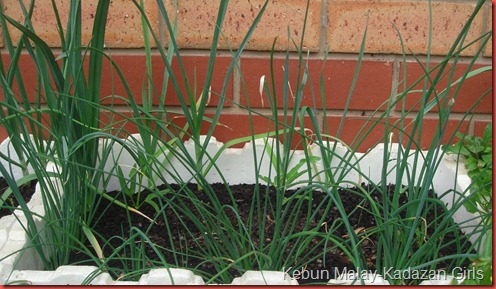 Do you think the chives will be good companion for kang kong (water spinach) living together in this polystyrene box. The kang kong is still a small seedlings hiding itself behind chives.
BROWN ONIONS
Brown onions grown from seeds. It looks similarly like spring onions at this stage of growth.


Onions grown from sets in August at the other side of the fence of our house. This is our first trial. Do you think it will produce onions? I am starting to have some doubt now.
This is the only allium which we are growing now for November update on allium. How about in your garden?
 I am glad that I decided to sow some poppy seeds last autumn for spring flowering as one of my new experience of growing flower from seeds for this year. Living in Mediterranean climate I found that sowing time play a very important role ensuring the success of certain plant. Growing up in tropics you can plant all year round. Here in Adelaide I had to do my own research on determining when is the perfect time to sow certain plant seeds I would love to grow. At first I thought I sowed those poppy seeds too late and they won’t produce any flower for me at all. I almost gave up on them and thought to clear them up to giveaway their space for other plants. I got worried because when I walk around my neighbourhood nobody has poppy plants in their front yard garden except this one house which grow Californian poppy that has bloom 2 months ago which mine has not even after a month back then. Luckily I was patient enough and now got to see the reward. There is so many different shade or colours of poppy blooming now in my garden. Which one is your favourite?

 The first time I touched poppy petals, my first thought was silk or soft tissues.
 Poppy don’t bloom that long about 3 or 4 days, the petals are easily carried away on windy day. But I am not worried because not long they will be new bloom to replace the old ones.
 Sexy red poppy dancing facing the sky.


